One Line Face: A Minimalist Embroidery Review
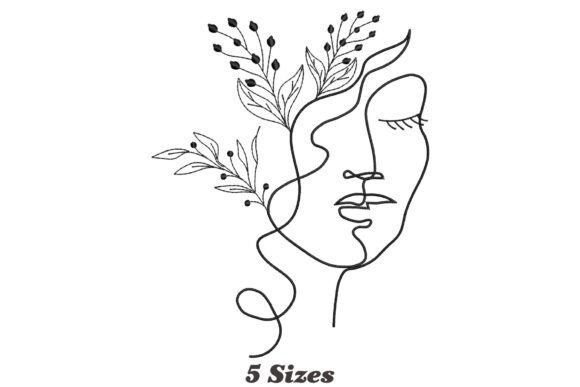
As a designer who has spent countless hours digitizing and stitching out thousands of patterns, I have learned that simplicity is often the hardest aesthetic to master. When I first loaded the One Line Face design into my software, I was immediately struck by its deceptive ease. It looks like a quick sketch, but in the world of machine embroidery, continuous line art requires precise pathing to avoid unnecessary jumps and thread breaks. This review explores how this specific design holds up not just as a digital file, but as a tangible element in real-world commercial and personal projects.
First Impressions and Visual Personality
The mood of One Line Face is undeniably modern and whimsical. It fits squarely into the current trend of abstract minimalism that dominates social media feeds and boutique home decor. Unlike complex floral motifs or dense satin stitch logos, this design relies on negative space and fluid movement. For those working in the Beauty category, this aesthetic is particularly potent. It suggests elegance without shouting, making it an ideal choice for brands that want to appear approachable yet sophisticated.
The visual personality here is playful. It does not take itself too seriously, which makes it versatile. Whether you are creating a high-end linen napkin set or a quirky tote bag for a local farmer’s market, the design adapts. However, because it is so sparse, every stitch counts. There is no fill stitch to hide imperfections, so the quality of your tension and the smoothness of your running stitch become the focal points of the finished product.
Real-World Application: The Tote Bag Test
To truly evaluate an embroidery file, you must imagine it on fabric. I recently considered using One Line Face for a custom order of canvas tote bags. These were intended for a small shop product launch, targeting young professionals who appreciate handmade touches. The challenge with tote bags is the texture; canvas can be coarse, and lightweight designs can sometimes get lost in the weave.
In this scenario, the single-line nature of the design worked in my favor. Because there is minimal stitch density, the fabric did not pucker, even without heavy-duty stabilizer. I chose a contrasting thread color—a deep charcoal on natural cotton—to ensure the lines remained crisp. The result was a clean, professional look that elevated the perceived value of the bag. Customers often associate intricate embroidery with higher cost, but they associate clever, minimalist embroidery with higher taste. This design delivers the latter.
Apparel and Custom Gifts
Beyond home decor, this design shines in custom apparel. I tested it on a sweatshirt, placing it subtly on the left chest area. Here, the scale was critical. If the design is too large, it loses its delicate charm; if too small, the details may blur. For sweatshirt embroidery, I recommend keeping the size moderate to maintain clarity. The running stitch lays flat against the fleece, avoiding the bulk that satin stitches might create on curved surfaces like shoulders or sleeves.
This versatility also makes it a strong contender for personalized gifts. Imagine this face embroidered on a baby onesie or a nursery pillow cover. It adds a touch of artistic flair without being overly juvenile. For holiday embroidery projects, such as personalized stockings or gift tags, the simplicity allows for quick production times, which is essential for craft business owners during peak seasons.
Technical Considerations for Designers
While One Line Face is forgiving in many ways, it demands attention to technical details. Since this is a line-based design, it likely utilizes running stitch or a very narrow zigzag. You must check the stitch density in your software before hitting start. If the stitches are too far apart, the line will look broken on textured fabrics. If they are too close, you risk perforating thin materials.
Fabric choice is paramount. On dark fabric, ensure your thread has enough sheen or thickness to stand out. Matte threads might disappear into the background. Conversely, on light fabric, a bold color can make the design pop. Always test the design on scrap fabric first. This is non-negotiable for any professional embroidery project. Check how the thread interacts with the fabric texture and adjust your tension accordingly.
Stabilizer selection is another key factor. For stretchy fabrics like t-shirts, a cut-away stabilizer is recommended to prevent distortion over time. For woven fabrics like towels or aprons, a tear-away might suffice, but given the minimal nature of the design, a light fusible stabilizer can help keep the fabric taut and the lines straight. Remember, there is no fill stitch to anchor the fabric, so stability comes entirely from your hooping technique and backing material.
Commercial Viability and Branding
For Etsy sellers and digital product sellers, One Line Face offers significant advantages. It is quick to stitch, which means lower production costs and faster turnaround times. This efficiency allows for better profit margins on handmade products. Furthermore, minimalist designs tend to have broader appeal across different demographics, reducing the risk of unsold inventory.
When creating printable mockups or digital embroidery file previews, this design photographs beautifully. Its clean lines translate well to screen, making it easier to market online. However, always confirm licensing terms before selling finished items. While many designers allow commercial use of their embroidery files, some restrict mass production. Ensure you are compliant with the specific license attached to this digital embroidery file.
Where to Use Caution
Despite its strengths, there are scenarios where One Line Face might struggle. Avoid using it on highly textured fabrics like bouclé or heavy wool unless you use a topping stabilizer, as the needle may skip or the line may get lost in the pile. Also, be cautious with very small hoop sizes if you plan to add text or other elements around the face. The design needs breathing room to maintain its airy feel.
Additionally, while it works well on caps, the curved surface can distort linear designs if not hooped perfectly. Use a cap frame and consider slightly reducing the size to accommodate the curvature. For items that require frequent washing, such as kitchen towels or baby clothes, ensure you use high-quality polyester or rayon thread that resists fading and breaking, as the single line has no redundancy.
Final Verdict
One Line Face is a valuable addition to any designer’s library. It bridges the gap between artistic expression and practical application. Whether you are creating an embroidered patch for a jacket, a tote bag design for a boutique, or a simple accent for home decor, this pattern delivers consistent results. It reminds us that in embroidery, as in life, sometimes less is indeed more. Just remember to respect the technical requirements of line work, choose your materials wisely, and let the simplicity of the design speak for itself.